Paul Samuelson (the first American Nobel Laureate in Economics, and arguably the most influential economist of the 20th century) died today at home at age 94. He was largely responsible for the transformation of economics from a largely descriptive and discursive discipline to a highly mathematical and rigorous one.
He was responsible for turning MIT into a world-class economics center - over the years, he played a role in bringing in Solow, Engle, Klein, Krugman, Modigliani, Merton, and Stiglitz.
In addition, he wrote perhaps the single most popular and widely used economics text in history - "Economics", published in 1948. I read it in my undergraduate years in the late 1970s, and it was still selling 50,000 copies a year in the late 1980s.
A giant has passed.
Showing posts with label Economics. Show all posts
Showing posts with label Economics. Show all posts
Sunday, December 13, 2009


Saturday, June 27, 2009
Even Children Can Understand Economics
Every once in a while (actually, make that "on a regular basis), the Unknown Daughter comes out with something that really floors me.
The other day, UD was asking about my grandparents. I told her that both grandfathers worked it the fabric mills in my hometown (back in the day, there were three mills in town). Somehow, the topic morphed into what happened to the mills, so I told her that the mills eventually moved a lot of their business down south, and then (eventually) overseas.
"Why?" she asked?
I answered, "Because the people there would work in the factories for less, so the mill owners could make the fabric more cheaply. Unfortunately, that means that a lot of the workers in the mill lost their jobs."
"So why did they do it if the workers lost their jobs?"
"Well UD, since it cost less to make, they could sell the fabric at a lower price. So, while the workers lost jobs, the people who bought it actually benefited. This means that some workers lost money, and the people who bought the fabric benefited."
Here's what she said: "But Daddy - the people who bought the fabric weren't the only ones who got something out of it. The people who sold the fabric and the people who owned the stores made more money, so they could spend more on other things, like movies and meals and stuff, so they helped the people who sold those things. And then those people had more money, so they could hire more workers, so they benefited, too."
I asked her how she came up with this idea, and she said she just did. Then she gave me "that look" (i.e. 8 years old going on teenager), and said, "After all--my dad IS a finance professor, so I should be smart".
After thinking about it, I realized that she'd gotten that right, too. But the "genetic" story wasn't what I was thinking about--she picked this up largely through osmosis, since I'm often trying to get the Unknown Wife to think in economic terms (i.e. who benefits and who loses, and how). Of course, when I do this, it only serves to tick UW off.
But UD misses little, and remembers most things she hears or sees. So, when she turns teenager, I'm in biiiig trouble.
I shared this with one of my colleagues, and he suggested that I should have UD talk with our state legislators - she could teach them a thing or two.
But given this Wall Street Journal article, I'm skeptical.
Monday, May 25, 2009
Googlenomics, Auction Theory, and Hal Varian
Like many programs, the Unknown Alma Mater's doctoral program used Varian's Economics text for our Micro Sequence. So, I perk up when I hear Varian's name mentioned.
It turns out he's Google's Chief Economist (who knew - Google has a chief economist?). A recent Steven Levy piece in Wired magazine talks about the ways the company uses economic theory (and auction theory in specific) in their Google AdWords program. Here are a couple of snippets:
It turns out he's Google's Chief Economist (who knew - Google has a chief economist?). A recent Steven Levy piece in Wired magazine talks about the ways the company uses economic theory (and auction theory in specific) in their Google AdWords program. Here are a couple of snippets:
At the time, most online companies were still selling advertising the way it was done in the days of Mad Men. But Varian saw immediately that Google's ad business was less like buying traditional spots and more like computer dating. "The theory was Google as yenta—matchmaker," he says. He also realized there was another old idea underlying the new approach: A 1983 paper by Harvard economist Herman Leonard described using marketplace mechanisms to assign job candidates to slots in a corporation, or students to dorm rooms. It was called a two-sided matching market. "The mathematical structure of the Google auction," Varian says, "is the same as those two-sided matching markets."Read the whole thing here.Varian tried to understand the process better by applying game theory. "I think I was the first person to do that," he says. After just a few weeks at Google, he went back to Schmidt. "It's amazing!" Varian said. "You've managed to design an auction perfectly."
...
AdWords was such a hit that Google went auction-crazy. The company used auctions to place ads on other Web sites (that program was dubbed AdSense). "But the really gutsy move," Varian says, "was using it in the IPO." In 2004, Google used a variation of a Dutch auction for its IPO; Brin and Page loved that the process leveled the playing field between small investors and powerful brokerage houses. And in 2008, the company couldn't resist participating in the FCC's auction to reallocate portions of the radio spectrum.
Google even uses auctions for internal operations, like allocating servers among its various business units. Since moving a product's storage and computation to a new data center is disruptive, engineers often put it off. "I suggested we run an auction similar to what the airlines do when they oversell a flight. They keep offering bigger vouchers until enough customers give up their seats," Varian says. "In our case, we offer more machines in exchange for moving to new servers. One group might do it for 50 new ones, another for 100, and another won't move unless we give them 300. So we give them to the lowest bidder—they get their extra capacity, and we get computation shifted to the new data center."
Saturday, December 20, 2008
Awesome Explanation of the Economic Crisis
I didn't realize this, but every year Harvard's Kennedy School invites new members of congress for a three-day "briefing" by Harvard profs on various topics. This year, Jeff Frankel came up with a graphic explanation of the current economic crisis. Here it is:

Now that's what I call an information-rich slide.

Now that's what I call an information-rich slide.
Monday, October 27, 2008
Finance and Economic Courses on the Web on The Web
Increasingly, people are putting their lectures, teaching material, and (in some cases), entire courses on the web. Here are a few I've recently come across:
A Short Course In Behavioral Economics: Daniel Kahneman (yes, the Nobel Laureate) has recorded and posted videos of a two day conference called "Thinking about Thinking".
Robert Schiller's Spring 2008 Financial Markets Class at Yale: Schiller has done a great deal of work in market efficiency, and also created the Case-Schiller Index of Home Prices.
While surfing through Yale's Open Classes, I also found a class titled Game Theory, by Ben Polak, a widely published economist. He seems to cover all the big topics: Nash (and other) Equilibrium concepts, Adverse Selection, Signalling, and even Evolutionary Game Theory.
If you know of other finance/econ classes on the web, let me know in the comments section and I'll post them here.
Tuesday, September 30, 2008
There Shall Be Only One (Bank, that is)
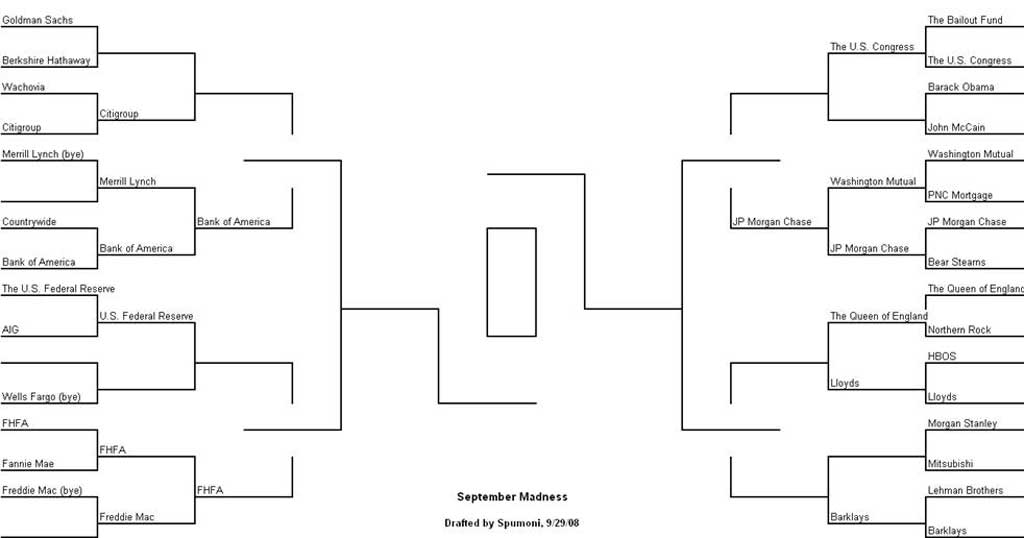
It's too early for March Madness, but here's a pool you can play if you're in the financial services industry - September Madness (click here for a larger version):

HT: Barry Ritholtx

HT: Barry Ritholtx
Friday, December 28, 2007
"Shocking" Economics Facts
I thought this short Youtube clip had some very interesting facts. They illustrate just how amazingly large our economy is relative to that of most countries. Let's just say that I'm glad to be living here.
Back to CFA studies.
Back to CFA studies.
Monday, October 15, 2007
Myerson, Maskin, and Hurwicz Win Nobel Economics Prize
Once again, I guessed wrong - Fama once again didn't get the nod. Instead, the prize went to three Americans who were instrumental in developing and forwarding the economics sub-field know as "mechanism design". Congratulations to Leonid Hurwicz of the U of Minnesota, Roger Myerson of the U of Chicago, and Eric S. Maskin, a professor at the Institute for Advanced Study in Princeton.
For more about them, read this piece in the NYTimes Online.
If I keep guessing Fama, I should eventually be right (as long as he stays healthy).
For more about them, read this piece in the NYTimes Online.
If I keep guessing Fama, I should eventually be right (as long as he stays healthy).
Thursday, August 30, 2007
Another Economics Blog List
CurrencyTrading.net has compiled a list of 100 Top Economics Blogs. Financial Rounds is listed under the "Blogs By Univesity Professors" section.
Check out their list. Present company excluded, it's pretty good.
Check out their list. Present company excluded, it's pretty good.
Friday, March 02, 2007
Friday Link Dump
It's been an interesting day at Unknown University. We had a huge storm blow through, and there was flooding in many buildings around campus. Unfortunately, one of the buildings housed the university servers, and they had to shut down before there were short circuits that could really mess things up. As a result, they cancelled afternoon classes, and I've had no internet access all day. In any event, there have been a few interesting things that came across my bloglines account, so I thought I'd post a Link Dump before I turned in for the night.
At the Super Returns PE conference, someone asked a number of PE bigwigs what keeps you up at night worrying. Dealbook reports their answers.That's all for now, folks.
Barry Ritholtz at The Big Picture put up some very nice analysis of of issues surrounding Tuesday's big stock market decline. And in a related piece, he presents the Top Ten Myths of Tuesday's Correction.
Greg Mankiw's top-selling economics principles text is centered around Ten Principles of Economics. Yoram Bauman (the world's only "stand-up economist") gives the unofficial, humorous version in this video.
The Wall Street Journal (online subscription required) reports on a large insider-trading scheme involving over a dozen individuals at investment banking firm UBS AG and several hedge funds.
Saturday, February 17, 2007
Two Nobel Winners For The Price of One
Today's Wall Street Journal has an interview of Nobel Prize Winner Thomas Schelling by his student Michale Spence (another Nobel winner). It's a must read - Schelling and Spence discuss nuclear deterrence and other weighty topics.
Monday, March 28, 2005
Capitalism, Socialism, and Imperfect People
As a finance professor, I am almost always in favor of free and competitive markets. However, when I discuss this with a non-economist, they often make an argument of the type, "but what about this market failure/inequity/problem?" Micha Gertner of Catallarchy answers:
click here for the whole article.
The point is that you can't compare capitalism with imperfect actors to a government with perfect, all-wise actors. Given imperfect people, I'll take the checks and balances associated with competitive markets.
Question for class: order the following in terms of desirability (and support your answers):
Of course, the simple and obvious response to this answer is that market competition does not always lead to ideal outcomes. True. But the mistake here is comparing market outcomes to a theoretical ideal rather than the next best alternative. What is the next best alternative - or at least the alternative offered by critics of market outcomes? Government.
click here for the whole article.
The point is that you can't compare capitalism with imperfect actors to a government with perfect, all-wise actors. Given imperfect people, I'll take the checks and balances associated with competitive markets.
Question for class: order the following in terms of desirability (and support your answers):
- Capitalism with perfect people
- Capitalism with imperfect people
- Socialism with perfect people
- Socialism with imperfect people.
Saturday, March 26, 2005
Profit vs. Charity
The Angry Economist is writing on the role of profits:
Click here for the whole article.
Thomas Sowell has written at length on the role of profit. He says that "for profit" firms should be more correctly called "profit AND loss firms", because losses indicate that the resources employed in the business would better benefit society as a whole elsewhere.
Profit has two pleasant characteristics. First is that profit attracts capital investment. If a company is making money, then more people are going to enter into the business. If the business of the company is saving the world, then the world will be saved all the faster. Second, profit tells you that you are actually helping people. Take, for example, the case of Christian missionaries who teach people how to read....the Bible. While the ability to read is surely a good thing, it's not clear that the people who now know how to read the Bible are better off. A primary tenet of profits in a free market is that everyone who trades is better off. Somebody who runs around a third world country teaching people how to use contraception because their country is overpopulated is not clearly doing them a favor.
Thomas Sowell has written at length on the role of profit. He says that "for profit" firms should be more correctly called "profit AND loss firms", because losses indicate that the resources employed in the business would better benefit society as a whole elsewhere.
Wednesday, March 23, 2005
Policy Analysis Market: Positive and Normative Perspectives (Catallaxis)
Daniel O'Connor at Catallaxis discusses the fate of the Policy Analysis Market (i.e. terrorism futures) in terms of both positive vs. normative economics. He first give us this background:
He finishes by recapping how the real nails in this idea's coffin came from normative arguments: that it was "morally offensive".
My sense is that arguments in the public sphere today about economic issues are much more likely to come from a normative perspective. I would also guess that the likelihood of a positive argument increases the more educated (particularly in business, economics, or logic) or politicially conservative the arguer is.
Click here for the whole article.
He then goes on to state some reasons why the PAM might not have been effective on positive grounds (including the possibility that participants might be state-monitored, the very high incentives of terrorists to send false signals, and the lack of a market in the underlying asset (the terrorist attack) on which the contracts are based).As Milton Friedman famously argued, positive economic analysis is designed to answer the question what is? with respect to economic development. It is concerned with understanding how the economic system has behaved in the past in order to predict how it will behave in the future. Normative economic analysis, in contrast, is designed to answer the question what ought to be? with respect to economic development. Therefore, it incorporates value judgments that are not necessarily grounded in the positive economic theories..
...Therefore, the debates over economic policy are often framed in terms of positive claims vs. normative claims that are difficult to reconcile, because one set of claims calls for empirical validation to ensure the policy works, while the other calls for ethical validation to ensure it is appropriate. Moreover, this framing is typically only implicit as the protagonists often have a difficult time differentiating the positive claims from the normative claims, thereby undermining their attempts at validation. Worse yet, many debates over the state’s economic policy are entirely based on competing normative claims that pit one ethical perspective against another ethical perspective, or one political philosophy against another political philosophy, with little or no recourse to positive theory and empirical evidence.
He finishes by recapping how the real nails in this idea's coffin came from normative arguments: that it was "morally offensive".
My sense is that arguments in the public sphere today about economic issues are much more likely to come from a normative perspective. I would also guess that the likelihood of a positive argument increases the more educated (particularly in business, economics, or logic) or politicially conservative the arguer is.
Click here for the whole article.
Monday, March 21, 2005
Good Economists=Bad Politicians
Stumbling and Mumbling has an excellent examination of why economists often make poor politician (like, for the umpteenth time, Larry Summers). Here's the first two:
- Economics is the study of trade-offs, of costs. It was, therefore, wholly natural for Larry Lindsey to discuss the costs of the Iraq war, and to be surprised when he attracted opprobrium: whoever thought wars were cheap? Politicians, of course, hate the idea of trade-offs and costs.
- Economists love counter-intuitive ideas. The two most successful theories in economics are probably comparative advantage and the invisible hand – things that don’t strike the layman as obvious. This leads to us stressing paradoxical notions – like the notion that outsourcing can be a good thing. Good politicians, by contrast, prefer sound-bites that corroborate the public’s prejudices.
Wednesday, March 16, 2005
Economics And Society (and Some Good Reading)
My grad school cohort and I often laugh at how training in economics has made us unfit for life outside "the tribe" (after all, how many people discuss a first date in terms of Bayes Rule?). When I try to explain how an economist would approach the issue du jour issue, they often look at my like I've grown another head (actually, they did that before I got a Ph.D., but that's another story). So, I'm always looking for good books to give to my non-economically trained friends.
Alex Tabarrok at Marginal Revolution gives this endorsement of Public Finance and Public Policy, the new textbook by Jonathan Gruber. He writes
Click here for the whole piece.
Two other gems that are probably more accessible are Basic Economics: A Citizen's Guide to The Economy and Applied Economics: Thinking Beyond Stage One, both by Thomas Sowell. The first book gives an excellent guide to microeconomics, with almost no equations. The second book is chock full of examples of the "Law of Unintended Consequences". Sowell comes from the school of "teaching by stories", and is probably the best source for non-economists trying to understand the economist's way of thinking. His writing is a perfect example of Einstein's charge to "make things as simple as possible, but no simpler".
And for a final recommendation (if just for the name), Tyler Cowen at Marginal Revolution recommends Freakonomics: A Rogue Economist Explores the Hidden Side of Everything, by Steve Levitt and Steven Dubner. It will hit the stores in early April.
Click here for the article.
Alex Tabarrok at Marginal Revolution gives this endorsement of Public Finance and Public Policy, the new textbook by Jonathan Gruber. He writes
Gruber is especially good at discussing empirical research. What is the effect, for example, of social security on private savings, on the living standards of the elderly, on the incentive to retire? What do we learn from the international evidence?
(Quick answers: Social security crowds out about 35 cents of private savings for every social security dollar. As a result, social security has reduced the eldery poverty rate although not quite as much as naive trends would suggest. Social security does reduce the labor force participation rates of the elderly but less so in the United States than in most European countries where there are huge disincentives for working beyond the normal retirement age. (Get the book or this powerpoint presentation for more details - note you need to view the PP in SlideShow mode to get the full effect.)
Gruber covers all the major programs - education, social security, unemployment insurance, Medicaid and Medicare, the tax system etc. - and in each case he carefully explains the institutional details and then he evaulates the empirical evidence focusing on the most telling pieces of evidence (rather than trying to cover everything that has ever been written as in a review paper).
Two other gems that are probably more accessible are Basic Economics: A Citizen's Guide to The Economy and Applied Economics: Thinking Beyond Stage One, both by Thomas Sowell. The first book gives an excellent guide to microeconomics, with almost no equations. The second book is chock full of examples of the "Law of Unintended Consequences". Sowell comes from the school of "teaching by stories", and is probably the best source for non-economists trying to understand the economist's way of thinking. His writing is a perfect example of Einstein's charge to "make things as simple as possible, but no simpler".
And for a final recommendation (if just for the name), Tyler Cowen at Marginal Revolution recommends Freakonomics: A Rogue Economist Explores the Hidden Side of Everything, by Steve Levitt and Steven Dubner. It will hit the stores in early April.
Click here for the article.
Saturday, March 05, 2005
Why Are Tickets For Different Movies Priced The Same?
Tyler Cowan at Marginal Revolution uses an economist's perspective to examine a lot of cultural issues. Today, he asks the question "Why Are All Movies The Same Price?:
Here's one I never would have come up with - a movie ticket is a call option! See why at Voluntary Exchange.
Well, not the same price in all cases. Before 6 p.m. is cheaper, there are numerous dollar theaters, and not all films allow for discount coupons. Nonetheless a multiplex will charge the same ($9.50 in my case) for the number one movie and for a flop. Nor is the price more expensive for Saturday night, or during the summer when demand is higher. Can any economic model predict these results?He provides eight possible reasons. Click here for the whole posting.
Here's one I never would have come up with - a movie ticket is a call option! See why at Voluntary Exchange.
Monday, February 28, 2005
Opportunity Costs, Renting vs. Buying, and Bad Economic Reasoning
Bill Cholensky over at Cattalarchy has a good example for explaining opportunity costs. He begins
It sometimes amazes me what passes for economic common sense. My pet peeve is the oft-repeated “throwing money away on rent” argument. It’s often followed by something like “You could be putting that money towards equity!”Click here for the whole piece.The idea that one is wasting money by paying rent is absurd. Has no one heard of Opportunity Cost? Buying a given house might be a good investment, but living in that house isn’t necessarily a good idea. A good investment is a good investment. A good place for one to live might be somewhere else. They don’t necessarily coincide.
Subscribe to:
Posts (Atom)