Here's the Stupid Professor Trick of the year. Apparently, not knowing how to turn off the external monitor can have serious consequences.
While his students were watching a movie on three screens, Suffolk University professor Luis Garciahe was busily watching porn on his laptop. Unfortunately for him, he didn't realize that he was also projecting it onto the big screen. But luckily for him (if not for his students) he's tenured, so he'll probably keep his job.
Of course, he was "just doing research for a later class module." Yep.
Supposedly, the class continued for 30 minutes after the incident, and none of the students mentioned it to Garcia. So, he remained blissfully unaware of what he'd done until one of the students reported it to the administration. I know that part couldn't have happened at my school, because I doubt my students could gone that long in class before asking "Will this be on the exam?"
Bugs Bunny has some thoughts on the matter, here, and Mike Munger has some further observations here, along with a link to a funny-but-not-work-safe video clip that I wish I'd thought about linking to.
Friday, March 10, 2006


How To Be An Expert
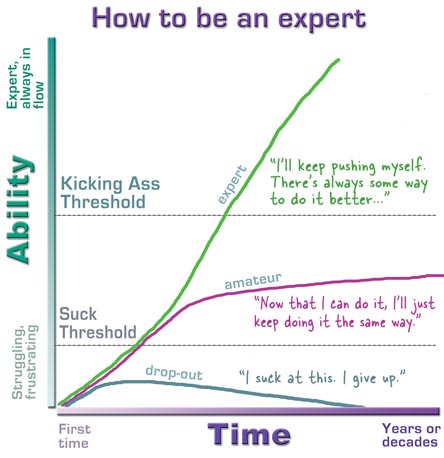
How do people become experts?

If you asked the guy on the street how the "best of the best" got that way (whether it's math, playing guitar, or whatever), they'd say that these people were born with a gift of some sort. Kathy Sierra at Creating Passionate Users disagrees, and she's written the best piece on this topic I've read all year:
The only thing standing between you-as-amateur and you-as-expert is dedication. All that talk about prodigies? We could all be prodigies (or nearly so) if we just put in the time and focused. At least that's what the brain guys are saying. Best of all--it's almost never too late.She also highlights some research by Florida State University psychology professor Dr. K. Anders Ericsson, who's made a research career out of studying prodigies, geniuses (of which I'm neither) and top performers:
In the book The New Brain (it was on my coffee table) Richard Restak quotes Ericsson as concluding:
Read the whole thing here."For the superior performer the goal isn't just repeating the same thing again and again but achieving higher levels of control over every aspect of their performance. That's why they don't find practice boring. Each practice session they are working on doing something better than they did the last time."
So it's not just how long they practice, it's how they practice. Basically, it comes down to something like this:
Most of us want to practice the things we're already good at, and avoid the things we suck at. We stay average or intermediate amateurs forever.
Reading Between the Lines
Joe Carter of the Evangelical Outpost has a great piece titled "Reading Between the Lines". It's a short translation guide to what some common phrases really mean. Here are a few choice snippits:
While you may not be able to read her mind, you do need to read in between the lines. Here is a brief guide to what people say and what it is they really mean:“I don’t kiss up to anybody.” -- Translation: I’m a tactless jerk.
“It’s not you, it’s me.” -- Translation: Let’s not kid ourselves, you’re definitely the reason we’re breaking up.
“We need to talk about our relationship.” (Spoken by a woman) -- Translation: We need to talk about what you’re doing wrong.“Fine, let’s talk.” (Coming from a man) -- Translation: Please, please, let’s get this over with before the football game comes on.
Read the whole thing here.
Thursday, March 09, 2006
Piled Higher and Deeper
If you're in the mood for a little bit of nerd humor, check out Piled Higher and Deeper. It's a comic strip that chronicles the live of four graduate students (three techies and a humanities student) as they work their way through their respective programs -
Be warned if you're a graduate student (or even junior faculty)-- there are several years of strips, so it could be a real time waster. On occasion, it nails the doctoral student experience.
Be warned if you're a graduate student (or even junior faculty)-- there are several years of strips, so it could be a real time waster. On occasion, it nails the doctoral student experience.
Wednesday, March 08, 2006
The Devil's Dictionary For Stock Markets
Since I learned of it in high school, I've been a big fan of the Devil's Dictionary (Ambrose Bierce's more than slightly sarcastic collection of alternate definitions for common words or phrases).
Now I find out that John Dorfman is working on one for the stock market. Here's a sample:
HT: The Big Picture
Now I find out that John Dorfman is working on one for the stock market. Here's a sample:
Pro forma earnings: A company's self-serving earnings statement in which unfavorable things are disregarded on the grounds that they don't really matter.Read the whole thing here.
HT: The Big Picture
Tuesday, March 07, 2006
Updates From The Job Hunt
I had my interview, and it went well. For the non-academics among you, here's how a typical faculty interview goes:
I flew in the night before. Unfortunately, this means that things started with a delay, since my destination airport was snowed in. There was an hour delay getting into the air, the plane had to circle the airport thrice before landing, and we ended up waiting on the runway for another 30 minutes after landing before taxiing to the terminal. But, we finally got in, and I went to dinner (around 7:30 or so) with a couple of the faculty from the school.
The next day, the interview started with breakfast at 7:30, followed by two separate 45 minute interviews with faculty, followed by a ninety-minute presentation of my current research, followed by lunch, followed another four 45-minute meetings with various other faculty (one of which was the Dean), followed by dinner with another faculty member, followed by a plane ride home.
Final tally - four meals with faculty, six 45-minute meetings with different faculty, a ninety minute research presentation and two plane rides - all within a little more than 27 hours. And then, collapse into bed exhausted for about 12 hours.
My impression was that it went well. It's very different (and oh, so much easier) interviewing for a job when you already have one. I was as relaxed as I've ever been on campus visit (and this is the 8th time I've had one of these over the years, so I've got some reference points).
I knew quite a bit about the faculty beforehand due to some personal connections, so I was very well prepared. The presentation went as well as any I've ever given (interestingly enough, a lot of that was thanks to tips on presenting I'd picked up around the blogosphere). I knew that there would be some accounting faculty in the audience, so I chose a topic that fit into the seams between finance and accounting, and I ended up with a lot of audience participation and some pretty good comments. I was a bit concerned before the presentation since there are a few "problem children" on the finance faculty, but they didn't bother to attend. From what the others had told me about these two, absence definitely makes the heart grow fonder, so even that worked out.
Everything I heard during the day convinced me that the position would be a great fit for me. And as we concluded our meeting, the Dean said, "UP, I'm very optimistic about your chances. And that's a very good sign, since I'm the one who makes the final decision".
Now, we wait to hear from them (the hardest part). I've been told by a friend on the faculty that an offer (if I get one) could be forthcoming as soon as next week. If it works out, I'll wait until my travel authorization for a conference next month is approved and then tell my current chair so (s)he can plan for next semester.
We have a joint accounting/finance department, and we lost two accounting faculty last year (we haven't filled their positions yet). In addition, one of our other accounting faculty just announced she's leaving in the fall.
So, when I tell our department chair, it's entirely possible his/her head may just explode on the spot.
Time for another nap, and then some grading.
UPDATE 1 (Saturday): I just heard from my friend on Unknown U's faculty, and he said that he has gotten uniformly positive feedback from everyone he's talked with - particularly regarding my presentation.
UPDATE 2 (Monday): According to my mole on the inside at Unknown U, my offer is currently winding it's way through the black hole of affirmative action. I should get a verbal offer in the next couple of days. I know that verbal offers aren't worth the paper they're written on (and I'll wait for the written one before I start mentally packing), but I still have to say,
Woo Hoo!
I flew in the night before. Unfortunately, this means that things started with a delay, since my destination airport was snowed in. There was an hour delay getting into the air, the plane had to circle the airport thrice before landing, and we ended up waiting on the runway for another 30 minutes after landing before taxiing to the terminal. But, we finally got in, and I went to dinner (around 7:30 or so) with a couple of the faculty from the school.
The next day, the interview started with breakfast at 7:30, followed by two separate 45 minute interviews with faculty, followed by a ninety-minute presentation of my current research, followed by lunch, followed another four 45-minute meetings with various other faculty (one of which was the Dean), followed by dinner with another faculty member, followed by a plane ride home.
Final tally - four meals with faculty, six 45-minute meetings with different faculty, a ninety minute research presentation and two plane rides - all within a little more than 27 hours. And then, collapse into bed exhausted for about 12 hours.
My impression was that it went well. It's very different (and oh, so much easier) interviewing for a job when you already have one. I was as relaxed as I've ever been on campus visit (and this is the 8th time I've had one of these over the years, so I've got some reference points).
I knew quite a bit about the faculty beforehand due to some personal connections, so I was very well prepared. The presentation went as well as any I've ever given (interestingly enough, a lot of that was thanks to tips on presenting I'd picked up around the blogosphere). I knew that there would be some accounting faculty in the audience, so I chose a topic that fit into the seams between finance and accounting, and I ended up with a lot of audience participation and some pretty good comments. I was a bit concerned before the presentation since there are a few "problem children" on the finance faculty, but they didn't bother to attend. From what the others had told me about these two, absence definitely makes the heart grow fonder, so even that worked out.
Everything I heard during the day convinced me that the position would be a great fit for me. And as we concluded our meeting, the Dean said, "UP, I'm very optimistic about your chances. And that's a very good sign, since I'm the one who makes the final decision".
Now, we wait to hear from them (the hardest part). I've been told by a friend on the faculty that an offer (if I get one) could be forthcoming as soon as next week. If it works out, I'll wait until my travel authorization for a conference next month is approved and then tell my current chair so (s)he can plan for next semester.
We have a joint accounting/finance department, and we lost two accounting faculty last year (we haven't filled their positions yet). In addition, one of our other accounting faculty just announced she's leaving in the fall.
So, when I tell our department chair, it's entirely possible his/her head may just explode on the spot.
Time for another nap, and then some grading.
UPDATE 1 (Saturday): I just heard from my friend on Unknown U's faculty, and he said that he has gotten uniformly positive feedback from everyone he's talked with - particularly regarding my presentation.
UPDATE 2 (Monday): According to my mole on the inside at Unknown U, my offer is currently winding it's way through the black hole of affirmative action. I should get a verbal offer in the next couple of days. I know that verbal offers aren't worth the paper they're written on (and I'll wait for the written one before I start mentally packing), but I still have to say,
Woo Hoo!
Monday, March 06, 2006
This Week's Carnival Of The Capitalists
This week's COTC is up at Free Money Finance. As usual, there are a lot of good posts in many different areas. Here are some that caught my eye:
Searchlight Crusade discusses what to do if you think you've been sold a bad mortgage.As always, look around. There's always lots of good stuff at the COTC, and my picks might not be what trip your trigger.
This one made me do a triple (not double) take. Roth & Company start out with : "Two women are donating kidneys to each other's husbands. ... they may have taxable income from the swap"
Going Private discusses why merger arbitrageurs haven't made a great returns recently. The main reason? The market for "corporate control" has become more efficient.
Photon Courier discusses some recent academic research that shows that investors switch in and out of mutual funds at the worst times.
James Hamilton at Econbrowser examines near term oil supplies.
Big Picture, Small Office recounts a few lessons he learned from watching a master negotiator.
Sunday, March 05, 2006
Maximizers and Satisficers
Do you shoot for the best, or do you settle for "good enough"?
A recent study by Barry Schwartz examined the outcomes (salaries and job satisfaction) of job choices made by "maximisers" and "satisficers". In case you're unfamiliar with the terms, the two types are simply those who shoot for the best possible outcome and those who are happy if they hit a certain target (i.e if they get a certain income, that's good enough and they're happy). Here's an excerpt:
How about you?
HT: Marginal Revolution
A recent study by Barry Schwartz examined the outcomes (salaries and job satisfaction) of job choices made by "maximisers" and "satisficers". In case you're unfamiliar with the terms, the two types are simply those who shoot for the best possible outcome and those who are happy if they hit a certain target (i.e if they get a certain income, that's good enough and they're happy). Here's an excerpt:
Five hundred and forty-eight graduating students from 11 universities were categorized as maximisers or satisficers based on their answers to questions like "“When I am in the car listening to the radio, I often check other stations to see if something better is playing, even if I am relatively satisfied with what I'’m listening to"”.I was a maximizer when younger, but I've become increasingly more of a satisficer over time. I wouldn't be surprised if that's the natural progression. As I've gotten older, I've come to the realization that only a very, very few things matter (I'll let you figure out what they are). So, I try to be more of a mazimizer for them. In order to do that, I settle for "good enough" in everything else.
When questioned again the following summer, the maximisers had found jobs that paid 20 per cent more on average than the satisficers'’ jobs, but they were less satisfied with the outcome of their job search, and were more pessimistic, stressed, tired, anxious, worried, overwhelmed and depressed.
How about you?
HT: Marginal Revolution
Saturday, March 04, 2006
Surviving Faculty Meetings
Ann Bartow at Feminist Law Professors lists Eight Types of Faculty Meeting Attendees.
I used to be a Talker when I started out, but I realized that no one cared what I said, and making the meeting drag on ticked people off. So now, I just sit in the back, keep quiet and read a journal article or two.
For new faculty, here are some simple rules for surviving faculty meetings without damaging yourself:
I used to be a Talker when I started out, but I realized that no one cared what I said, and making the meeting drag on ticked people off. So now, I just sit in the back, keep quiet and read a journal article or two.
For new faculty, here are some simple rules for surviving faculty meetings without damaging yourself:
Rule #1:Thou shalt keep thy mouth shut until tenured.HT: Steve Bainbridge.
Rule #2: If you have great comment to make, refer to rule #1.
Rule #3: Always bring something to work on unobtrusively in the back. Use the time to catch up on your journal reading. This will help you to follow rule #1.
Rule #4: Come early enough so that you can sit in the back (see Rule #3).
Rule#5: Do not take sides in contentious disputes. Just. Don't. If you take someone's side they won't remember it ten minutes later, and those on the other side may hold it against you.
Rule #6: If you want to be seen as a contributor and just can't live with yourself without speaking up, limit yourself to ONE comment per meeting, of no more than 15 seconds' length. So, choose carefully. Better yet, refer to rule #1.
Wednesday, March 01, 2006
Academic AWOL
From time to time, almost every academic gets behind on their work. If you've promised something to someone else (like a referee report, a chapter of a dissertation, or some work for a co-author) and you're past deadline, it's natural (wrong, but natural) to avoid the other person involved.
Of course, the later you get, the less you want to see the other person, and the higher the standard you hold yourself to (the "If I'm going to turn it in late, I'd better make it REALLY good" syndrome). Of course, this makes it more likely that you'll procrastinate. After a while, it spirals out of control, and you avoid the other person at all costs, sometimes to comical extremes.
Mary McKinney at Academic Coach has a great piece on this problem over at Inside Higher Education. It's titled Academic AWOL, and it should be required reading for doctoral students and junior faculty everywhere.
Of course, the later you get, the less you want to see the other person, and the higher the standard you hold yourself to (the "If I'm going to turn it in late, I'd better make it REALLY good" syndrome). Of course, this makes it more likely that you'll procrastinate. After a while, it spirals out of control, and you avoid the other person at all costs, sometimes to comical extremes.
Mary McKinney at Academic Coach has a great piece on this problem over at Inside Higher Education. It's titled Academic AWOL, and it should be required reading for doctoral students and junior faculty everywhere.
Subscribe to:
Posts (Atom)